


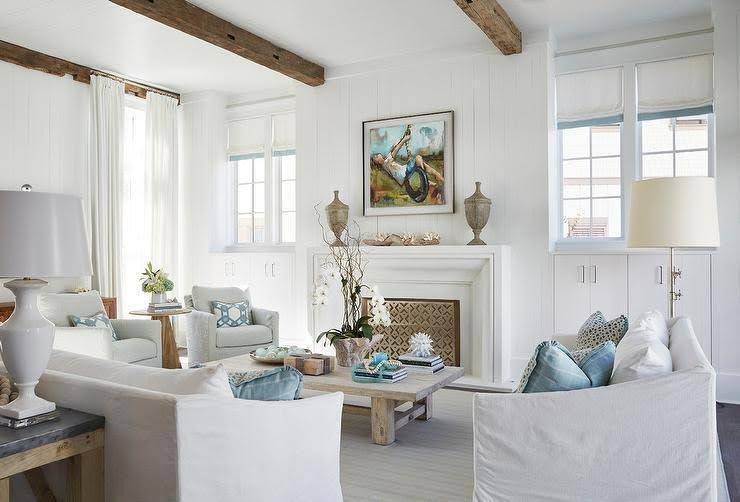
A pale, washable sitting room does not require a water view or a custom sofa. It requires edit, scale, and a few good fabrics.
A small living room goes coastal the same way a large one does — white or cream walls, a sofa you can wash, something woven on the floor, and daylight that is allowed to hit the boards. The difference is what you skip. You skip the second sofa. You skip the built-in that costs more than the furniture. You skip the navy wall. Twelve ideas. Most of them are decisions, not purchases.
1. Paint is the cheapest renovation
One gallon of a warm white — think Swiss Coffee, Cloud White, or a similar creamy off-white — will do more for a small room than a new coffee table. Paint the trim the same color as the walls if the millwork is fussy. A single envelope makes a tight room read larger and quieter. Save the blue for a pillow.
2. Buy one washable sofa. Stretch everything else.
The sofa is the only piece worth stretching for. A simple slipcovered or performance-linen sofa in cream or oatmeal is the whole coastal look. Look at floor models, last-season covers, and secondhand frames you can recover. A heavy white canvas drop cloth, hemmed, will fake a slipcover on a decent frame until the real cover is in the budget.

One cream sofa, greenery on the table. In a small room you only need one sofa. The second seat can wait.
3. Scale down. Do not shrink the rug.
A small room wants a sofa that does not eat the walkway — often 72 to 84 inches, not a 96-inch sectional. What it does not want is a postage-stamp rug. Front legs of every seat on the rug, even if that means an 8×10 in an 11-foot room. A cheap jute or sisal from a big-box store is the right texture and the right price.
4. Hang the curtains high and wide — even if they are inexpensive
A $30 rod mounted four inches below the ceiling, and panels that kiss the floor, will do more than custom silk. White or unbleached cotton. Stack the fabric off the glass. If you cannot afford two widths per side, one panel per side still lifts the room. Skip the valance.

Sheer panels to the floor, a pale sofa, oak boards. The window is doing the expensive work.
5. One good lamp beats a matching set
Hunt a single ceramic or wood lamp at a thrift store and put a plain white shade on it. Pair it with a paper lantern or a simple floor lamp from a budget retailer. Matching pairs look like a catalog. Mixed heights look like a house. Soft white bulbs. No exposed Edison glare.
6. Keep blue in the small work
In a small room, a navy sofa or a navy wall will close the space. Put the color on two pillows, a throw, or a ginger jar from the sale aisle. The walls and the large upholstery stay cream. That is how a tight room still feels like a white coastal house.

Blue stays on the sofa and the chairs. The walls and the trim stay light. A small room can still take a little pattern.
7. Skip the built-ins. Fake the shelf.
Custom bookcases are a renovation. A pair of white IKEA or thrift bookcases, painted the wall color and set on a simple plinth, will read as millwork from five feet away. Leave air on the shelves. Baskets on the bottom hide the toys and the charging cords.
8. One table in the middle. Not three.
A small room cannot take a coffee table, two nesting tables, and a trunk. Choose one: a simple oak or painted-wood rectangle, or a round that lets people walk around it. A large tray on top corrals books so the surface still looks half empty. Thrift the table. Spend on the tray if you have to.

Two pale sofas, one wood table, a sisal rug. Small rooms want fewer, quieter pieces — not a miniature great room.
9. Let the window be the art
If the view is trees or sky, do not hang a gallery wall over it. One quiet print or nothing. A small room with too many frames looks busy, not collected. If you need something on a blank wall, one large inexpensive print in a simple wood frame is cheaper — and calmer — than six small ones.
10. Plants and grocery flowers do the expensive work
A fiddle-leaf or olive tree from a grocery or big-box nursery, and hydrangeas or eucalyptus in a clear jar, will photograph like a styled house. Rotate cheap stems weekly. Dead plants and dusty faux stems do the opposite. One real thing on the table is enough.

A compact sofa, a plant, a simple table. The formula is pale seating and daylight.
11. Hide the television or treat it as furniture
A black screen on a white wall is the loudest object in a small room. Pull it into a white cabinet with doors, hang it over a quiet mantel, or frame it. Do not build a shrine of sound bars and extra consoles. One low white media bench is enough.
12. Edit before you shop
The most expensive mistake in a small coastal room is buying more. Walk through and remove one object from every surface. If the coffee table still looks styled after you take the extra candle and the third book, you are done. Budget rooms look high-end when they are unfinished in the right places.

Pale seating, sheer curtains, the view doing most of the decorating. Stop one object short.
Spend on the sofa and the paint. Steal the rest.
A weekend plan that stays under a few hundred dollars
Saturday morning: paint. Saturday afternoon: hang the rod and the panels. Sunday: move the furniture so the sofa floats off the wall by a few inches, get every front leg on the rug, and put one lamp and one vase of flowers on the table. Do not buy a new sectional this weekend. See how the room feels when it is only white, woven, and half empty.
If there is money left, it goes to a slipcover or a better lamp — not another pillow. The room you want is already a pale envelope. The budget version is the same room with fewer objects in it.
Small rooms do not need a smaller idea of coastal. They need a quieter one.
THE COASTAL HOME


