


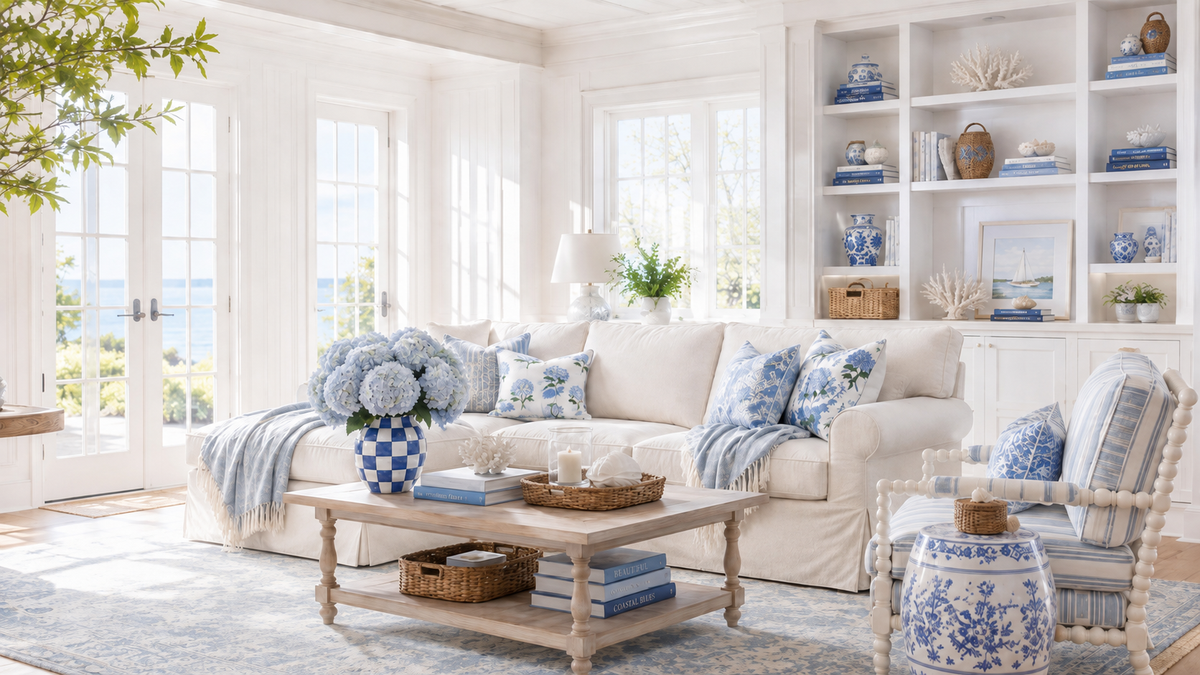
A sitting room that feels like a long afternoon — washable, pale, and unfinished in the right places.
A coastal living room is not a theme. It is a set of habits: keep the envelope quiet, put something woven underfoot, leave the coffee table half empty, and make sure a damp towel would not ruin the sofa. Twenty ideas. Steal the ones that fit the room you already have.
1. Start with a sofa you can wash
Cream or oatmeal slipcovers are the backbone of a relaxed living room. If a full slipcover is not in the cards, a heavy linen throw over the seat and arms gets you most of the way there. The silhouette should look sat-in, not tailored.
2. Size the rug like furniture, not like a stamp
Front legs of every seat on the rug. A floating rectangle of jute in the middle of the floor makes the room look smaller and more nervous. Natural fiber — jute, seagrass, a flat wool in sand — hides grit and softens pale boards.

Two white slipcovers, hydrangeas, built-ins left with air. Washable sofas. That is the whole sofa decision.
3. Let the window be the largest object
Hang the rod high and wide. Stack the fabric off the glass. Skip the heavy drape if privacy allows. A living room feels coastal the moment daylight can land on the floor without fighting a valance.
4. Use a wood table that already looks used
A bleached oak coffee table, a plank with a white base, a round piece with a worn top — something that can take a glass and a book. Glass-and-chrome reads like an office. The table is where the room proves it is lived in.
5. Keep blue in the small work
Pillows, a throw, one chair, a lampshade. When the sofa and the walls and the rug are all trying to be blue, the room stops being relaxed and starts being a catalog spread. One temperature of blue is enough.

White slipcovers, pale walls, porcelain only as the accent. Blue lives on the pillows and one chair.
6. Add one stripe and then stop
A pillow, a throw, or the binding on a rug. Stripe is the coastal pattern that does not need a seashell to explain itself. Two competing stripes in the same seating group is how rooms get busy.
7. Seat people so they can talk
Two sofas facing, or a sofa plus two chairs across a table — not a single sofa aimed at a television like a waiting room. Relaxed living rooms are conversation first. The screen can live on a cart or behind a panel.

A white conversation square: slipcovers, herringbone sisal, one table. Face each other.
8. Put an ottoman in the middle instead of another table
A round wicker or upholstered ottoman holds a tray, extra feet, and a stack of books. It softens the center of the room in a way a hard rectangle cannot. Leave the tray on it so the surface still works.
9. Give the fireplace a quiet job
If you have one, keep the mantel spare: one picture or one object, not a collection. Built-ins on either side should hold books, baskets, and a little empty air. The firebox can stay dark. You do not need coral on the hearth.

Two white sofas and a woven ottoman. The table in the middle is soft. Feet allowed.
10. Style the shelves like a pause, not a store
Stack some books horizontally. Leave a bay empty. Mix one ceramic, one basket, one plant. If every shelf is full, the room hums. Coastal living rooms need a place for the eye to rest.
11. Bring in one piece of rattan or cane
A chair, a side table, a lamp, a media cabinet with cane doors. One woven piece is texture. Four woven pieces is a patio set that wandered inside. Pair it with upholstery so it does not float.
12. Warm the cool palette on purpose
Unfinished wood, a terracotta pot, a camel pillow, brass that is allowed to dull. All-white-and-blue without a warm note photographs well and lives cold. One warm object is usually enough.

White envelope, a wall of windows, one navy table. The glass is the largest object in the room.
13. Make the coffee table earn less
A tray, a book, a bowl or a vase. That is a finished table. When the surface becomes a display of collected objects, the room stops being a place to put down a drink. Edit it on Sundays.
14. Light the room at night like late afternoon
Two lamps at sitting height beat a bright ceiling. Warm bulbs. A floor lamp in a dark corner. Overhead light flattens linen and makes white walls look institutional. Dim everything one notch lower than you think.
15. Hang one quiet picture, not a gallery of the sea
A single horizon, a pale abstract, or nothing at all if the windows are doing the work. A wall of framed shells and boats is the opposite of relaxed. If you collect art, mix it — do not theme it.

White mantel, pale seating, windows on three sides. The fireplace stays quiet.
16. Let a plant do what an accessory cannot
An olive tree, a fig, a palm in a simple pot. Green reads coastal because it is alive, not because it is nautical. One large plant is better than five small ones scattered on every table.
17. Keep throws where a body would drop them
Over an arm, not folded into a retail stack. Linen or cotton, not a fake-fur throw in aqua. The living room should look as if someone already sat down.
18. Treat a sunroom as a second living room
If you have the glass, furnish it with a real sofa or a daybed, a rug, and a table that holds a cup. Rooms that are “for later” never get used. Make it as comfortable as the main seating group and people will migrate.

A white sunroom used as a sitting room: wicker, a garden through the doors, real furniture.
19. Hide the visual noise
Baskets for throws and toys. A lidded box for remotes. Cords off the floor. Relaxed is partly what you cannot see. A coastal living room that is messy in a permanent way just looks unfinished.
20. Stop one object short
After the sofa, the rug, the table, the lamp, and the plant — walk out and come back. If the room already says easy, do not add the coral sculpture. Leave the air. The most relaxed rooms always look like they could take one more thing, and then they don’t.

White slipcovers, sisal, and one stripe on the pillows. Then stop.
A relaxed coastal living room is a washable sofa, a rug that reaches the chairs, a table you can use, and the nerve to leave the rest of it alone.
This weekend: move the rug out until it catches the front legs, take three things off the coffee table, and turn off the overhead. That is ideas 2, 13, and 14. The room will already sit differently.
Twenty ideas. The room only needed a few.


