


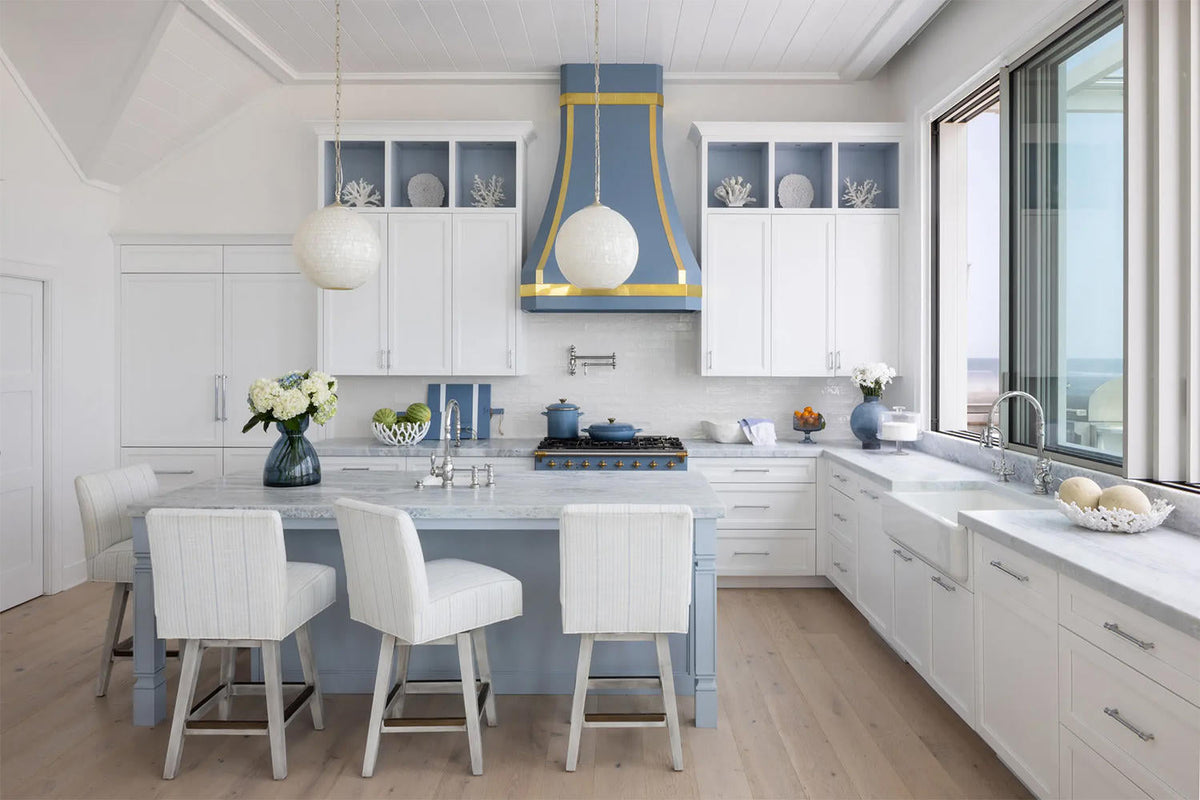
Not souvenirs. Not a theme. Twenty-five ways a house on any street can live like a Nantucket summer — rooms that stay light, layered, and quietly expensive.
Coastal living is a way of furnishing a life, not a coastline. The rooms that work — in East Hampton, on Nantucket, Hawaii, or a thousand miles inland — share the same habits: a pale envelope, one blue that means it, natural texture, and the discipline to stop before the room starts explaining itself.
Use this as a shopping list or as a slow renovation. Start wherever the house already wants to breathe.
THE ENVELOPE
1. Paint the room like morning light
Walls, trim, and ceiling in the same family of soft white or warm greige make a room feel larger and calmer before a single accessory arrives. Coastal living starts with the envelope, not the objects. Choose a white with a little warmth so evening lamps don’t turn the space blue-gray and chilly.
2. Commit to one hero blue
Pick a single blue — powder, hydrangea, or navy — and let it recur. Mixing five unrelated blues is how a room starts to look like a catalog collage. Tonal variation is welcome. Unrelated shades sitting side by side are not.
3. Keep large furniture quiet
Sofas, beds, and dining tables should be the neutrals. Color and pattern belong on things you can fold, wash, or move: pillows, stools, a runner, a lampshade. That is how a coastal house stays current without a full redo every season.
SIT AND GATHER
4. Slipcover the seating
A washable slipcover is the most practical luxury in a coastal house. Cream or pale stone linen hides nothing and forgives everything. The silhouette should be simple — rolled arm, skirted base — so the fabric, not the carving, does the talking.

Navy wing chairs, a monogram pillow, and a woven tray of coral: coastal grandmother, edited.
5. Mix stripes at more than one scale
A wide awning stripe on a stool, a pencil stripe on a pillow, a ticking stripe on a bench. Same family, different widths. That is the Hamptons trick — pattern that feels collected, not matched.
6. Put a rattan bench at the table
A woven bench opposite upholstered chairs keeps a dining room from feeling formal. It also seats an extra guest without buying another chair. Look for cane, rattan, or seagrass in a light, unfinished tone.

White table, rattan bench, a banquette in the window. Coral pillows are the only warm note — and they are enough.
7. Build a banquette if you have a window
A built-in seat under a run of windows is the most coastal piece of architecture you can add. Loose cushions in a performance linen, a few lumbar pillows, and you have breakfast, homework, and late-afternoon reading in one place.
THE KITCHEN AS LIVING ROOM
8. Paint or panel one architectural moment
A range hood in a quiet blue, a paneled island, a beadboard ceiling — one strong architectural move is more coastal than twenty accessories. Keep hardware simple: polished nickel or unlacquered brass.

White cabinetry, a herringbone marble backsplash, and chevron rattan stools. The stools are the entire color story.
9. Give the island woven stools
Rattan or cane counter stools do more for a kitchen than any backsplash tile. They add the texture coastal rooms starve without, and they photograph like a vacation even on a Tuesday.
10. Hang lanterns, not jewels
Wood-framed lanterns, plaster globes, or simple metal cages read coastal. Crystal does not. Scale them larger than you think — two over an island, not four timid ones.
11. Keep the backsplash quiet and the counters honest
Marble, quartzite, or a pale stone that can take a lemon and a wet glass. Herringbone or a simple subway is plenty. Busy pattern on the wall fights the light the room is trying to keep.
TEXTURE AND THE COLLECTED SHELF
12. Style a bookcase like a tide line
Stacks of books on their sides, a pair of ginger jars, one piece of coral, a woven box, empty air. Repeat the rhythm across the shelves. Do not fill every inch. Coastal living is as much about the gaps as the objects.

A Hamptons bookcase: ginger jars in pairs, navy books as color blocks, hydrangeas, and a white orb lantern tying the whole wall together.
13. Ginger jars in pairs, not crowds
Two of a kind on a shelf, or one hero jar used as a vase. A dozen small ones scattered around the house reads like a gift shop. Blue-and-white porcelain is the jewelry of this look — wear a little.
14. Make a tray the smallest room in the house
A rattan tray on a coffee table or console can hold a stack of plates, a lidded box, a cloche of coral, and a small bowl. It is a vignette you can lift and dust in one motion — the definition of livable decorating.

Blue-and-white porcelain, a cloche of coral and starfish, all corralled in rattan. This is how you nod to the beach without decorating with it.
15. Treat coral and shells as sculpture
One piece under glass, or one large branch on a stack of books. Never a bowl of mixed shells on every surface. If it would look right in a natural-history case, it belongs. If it would look right in a boardwalk stall, it does not.
SLEEP AND WASH
16. Choose a cane or rattan bed
A woven headboard is instant coastal architecture. Pair it with white or pale blue bedding and skip the rope, the oars, and the word “beach” embroidered anywhere.

Cane bed, ticking and matelassé, woven lamps. The oars on the wall are the one nautical note — framed, spare, and done.
17. Layer bedding the way you layer a living room
Crisp sheets, a quilt or coverlet, one textured throw, two sleeping pillows and two decorative. Pattern on the shams is enough. A bed that is all pattern is a bed that cannot rest.
18. Hang woven shades, not heavy drapery
Matchstick, bamboo, or linen Roman shades filter light without stealing it. If you need privacy, add a simple linen panel on a rod mounted high and wide. The window should still feel like a window.
19. Give the powder room permission to be louder
This is the one room where a bold stripe, an ikat, or a small-scale floral can go on all four walls. Keep the sink and fittings classic — marble, brass or nickel — so the pattern feels considered, not cute.

A powder room in blue ikat with a marble console sink. Pattern is allowed here because the rest of the house stays quiet.
20. Warm the cool rooms with brass
Unlacquered brass on a faucet, a picture light, or a cabinet pull keeps an all-white, all-blue house from feeling sterile. Let it tarnish. Coastal living is not a showroom.
ROOMS THAT LIVE OUTSIDE
21. Treat the sunroom as a real room
Upholstered seating, a proper table, a sisal or seagrass rug. If the furniture cannot stay out in a drizzle of mood, it does not belong in a sunroom either. This is where the house practices being on vacation.

A sunroom of rattan, palms, and a stripe that went coral instead of navy — proof coastal living is a temperature, not a color.
22. Repeat indoor materials outdoors
Teak, painted wicker, performance linen in the same stripe you used on the sofa. Continuity between the porch and the living room is what makes a house feel designed rather than staged for summer.

An East Hampton porch: painted wicker, a coffered ceiling, French doors onto the lawn. The garden is the artwork.
23. Use live green the way other people use art
A fiddle-leaf, a citrus tree in a woven basket, hydrangeas in a ginger jar, eucalyptus in the guest room. Greenery is the cheapest way to make a pale room feel finished. Replace the stems before they apologize.
24. Light the house like late afternoon
Lamps at sitting height, warm bulbs, and as little recessed glare as you can get away with. Coastal rooms should look good at 4 p.m. with the curtains open and at 8 p.m. with only the lamps on. If a space only works in noon sun, it is not finished.
25. Edit like a collector, not a gift shop
Two or three coastal references per room. Then stop. A bowl of sea glass, one abstract that hints at water, a piece of driftwood with air around it. The highest version of this look is the one that could pass, at a glance, for simply a well-lived pale house.
The test: if you removed every shell, every stripe, and every ginger jar, would the room still feel light, textured, and calm? If yes, you are doing coastal living. If no, you are doing a theme.
Start with the envelope and the seating. Add one woven thing, one blue thing, and one living thing. Live with that for a week before you buy anything else. The house will tell you what it still needs — and, more usefully, what it does not.
A second notebook. Same coast. Different rooms.


